-
Monday, April 5, 2010
Apple nano Money
Finding checks in the mail is always fun, but if I knew it would take this long to get my Apple iPod nano scratch settlement money, I would have asked for $40.00 off the purchase of a new Apple iPad.
Saturday, March 13, 2010
The End of Anonymity, The Beginning of Privacy
Contrary to what the movie Fight Club may have you believe, you actually are a unique snowflake. For evidence of this, just take a look at the Netflix Prize dataset (it contains 500 thousand records - users, and about 200 movie ratings per record). Statistically speaking, 90% of the records do not have a single other record that is more that 30% similar to it. In other words, the vast majority of Netflix users have rated a very unique set of movies.
Netflix, being very concerned about the privacy of their users, has removed or anonymized so called personally identifying information (name, email, age, address, etc) before releasing the dataset. However, the very notion of personally identifying information is flawed. In fact, all information can be personally identifiable. That is, any information could be used to identify an individual.
Taking a look at the Netflix dataset again, we find that on average, two movies is enough to reduce the candidate records to eight. And four movies is all it takes to uniquely identify one record. Another way to put it is, if you know just four movies that your friend has rated and you know that he is in the Netflix dataset, then it's very likely that you can find his record and learn the other movies that he has rated. This could be potentially embarrassing (gay porn) or dangerous (politically charged movies) for him. In fact, people have carried out attacks like this by linking the "anonymized" Netflix data with publicly available IMDB rating data to learn the identities of several "anonymized" Netflix users.
Previous definitions of privacy that were based on personally identifying information (quasi-identifiers) were flawed for this reason. k-Anonymity (syntactically transforming the dataset so that quasi-identifiers must appear in at least k records) does not guarantee privacy. Privacy is not a property of the data, but a property of computation carried out on the data. A better definition of privacy is differential privacy. Differential privacy basically means that including or not including a particular record has no significant effect on the computation result. Or in other words, your privacy has the same chance of being violated whether you participate in the computation or not.
[Reference Video]
Netflix, being very concerned about the privacy of their users, has removed or anonymized so called personally identifying information (name, email, age, address, etc) before releasing the dataset. However, the very notion of personally identifying information is flawed. In fact, all information can be personally identifiable. That is, any information could be used to identify an individual.
Taking a look at the Netflix dataset again, we find that on average, two movies is enough to reduce the candidate records to eight. And four movies is all it takes to uniquely identify one record. Another way to put it is, if you know just four movies that your friend has rated and you know that he is in the Netflix dataset, then it's very likely that you can find his record and learn the other movies that he has rated. This could be potentially embarrassing (gay porn) or dangerous (politically charged movies) for him. In fact, people have carried out attacks like this by linking the "anonymized" Netflix data with publicly available IMDB rating data to learn the identities of several "anonymized" Netflix users.
Previous definitions of privacy that were based on personally identifying information (quasi-identifiers) were flawed for this reason. k-Anonymity (syntactically transforming the dataset so that quasi-identifiers must appear in at least k records) does not guarantee privacy. Privacy is not a property of the data, but a property of computation carried out on the data. A better definition of privacy is differential privacy. Differential privacy basically means that including or not including a particular record has no significant effect on the computation result. Or in other words, your privacy has the same chance of being violated whether you participate in the computation or not.
[Reference Video]
Tuesday, March 9, 2010
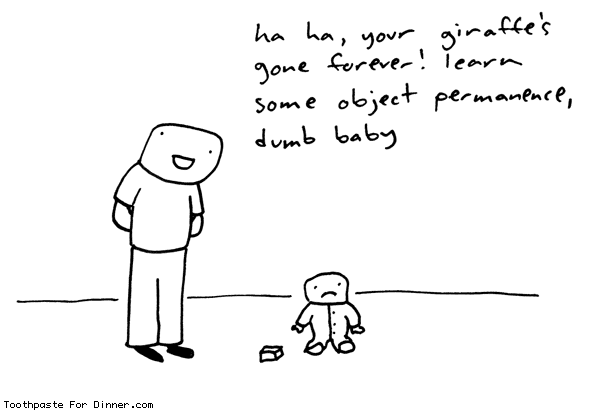
Computational Developmental Robotics
[Comic: Toothpaste For Dinner]
At first glance, human babies don’t seem that bright. They eat, they sleep, they cry. But they also learn at an astounding rate. While they are still in the womb, they learn proprioception, where their limbs are in relation to themselves, and how to move them. When they are born, they need to quickly learn how to breathe (just-in-time learning, if you will). They also get access to an entirely new sense - vision. Babies learn face recognition, structure from motion, and depth from stereo faster and better than the state of the art computer vision algorithms. Similar things can be said for a baby learning how to move about and manipulate its environment (robotics), learning how to understand and communicate with others (computational linguistics), and learning how to enjoy music (beat detection). Even more incredible, is that all this learning is going on while the baby’s brain grows from a single cell when the baby is in the womb, to the complex network of neurons in a developed brain. It’s like learning how to fly a plane as it is being assembled from parts all around you.
Artificial intelligence is a field with a lot of cool stuff happening. We have computer programs that can beat human grandmasters at chess, spam email filters that operate at over 99% accuracy, and programs that can compose piano music indistinguishable from the greats. But, how much of this can we actually call artificial intelligence, and how much is hand-wavy fakery? Can Deep Blue learn how to play Go? Can a spam filter learn to love? Why is it that a baby can learn to solve any problem and adapt to any environment, while we haven’t even come close to creating a robot with such versatility and adaptability?
The problem may be that artificial intelligence has been too focused on advanced behaviors like game playing (chess), classification (spam filter), and rule breaking (computational creativity) and less so on fundamentals like motivation, environment modeling, and agent self-introspection. After all, you must learn how to crawl before you can run.
tl;dr – Babies are awesome. We need to learn how they learn.
Thursday, March 4, 2010
Don't Pepper Spray me Brotender!
This is what happened last night. My friend David and I went to Trinity nightclub in downtown Seattle at around 9:45pm (Wednesday night is free cover and $3 beers). We go in and the bartender immediately checks our IDs. The bartender notices I have a half empty plastic bottle of Cha Dao Black Tea and Coffee Yin Yang (awesome drink by the way), and asks me to hand it over. I don't really understand why, but I reluctantly do so. Then I jokingly say to David, "I guess they have a no tolerance policy here". The bartender overhears this and gets really angry. He basically says if we don't like it we can leave. I feel the bartender is being a dick, so I ask to see his manager. This seems to piss him off even more. He says that it's not possible and then tells us to get out.
At this point, I feel the bartender is being a total douchebag. I go with David past the bar area and walk to the dance floor area looking for someone less dickish that I can talk to. To my utter surprise, the bartender has followed me and he's carrying a bottle of pepper spray and is threatening to use it on me. I really don't want to get pepper sprayed so David and I quickly leave.
I realize that you're only getting my side of the story here, but I just want to highlight two things that can be confirmed by the other patrons and David:
On a lighter note, I find it funny that I seem to be prone to bad luck whenever I go out on my birthday.
At this point, I feel the bartender is being a total douchebag. I go with David past the bar area and walk to the dance floor area looking for someone less dickish that I can talk to. To my utter surprise, the bartender has followed me and he's carrying a bottle of pepper spray and is threatening to use it on me. I really don't want to get pepper sprayed so David and I quickly leave.
I realize that you're only getting my side of the story here, but I just want to highlight two things that can be confirmed by the other patrons and David:
- The bartender chased after me with a bottle of pepper spray in his hand and threatened to use it on me.
- I never made any threats, or even hinted at violence or getting physical. I made it clear to the bartender that violence was the last thing I wanted.
On a lighter note, I find it funny that I seem to be prone to bad luck whenever I go out on my birthday.
Monday, February 22, 2010
4 Things the Post Office Can't Do
The post office recently failed to deliver a package to me. In trying to understand why, I've discovered 4 things that the post office simply cannot do.
1. Deliver my package.
This is the online tracking page for the package in question. Notice how it made it all the way to Bothell, WA (where I live), but it was never actually delivered to me. Instead it was marked "Return to Sender" without my knowledge.

2. Explain why they can't deliver my package.
So I called my local post office looking for an explanation. After getting tossed around their phone tree a few times, the response I got was: generally, a package getting marked "return to sender" means there's something wrong with the address.
3. Help me figure out what went wrong.
That's alright I think, mistakes happen. However, when I then ask what the incorrect address was that caused the package to be marked "return to sender", nobody can answer me. I'm beginning to smell some BS. I also checked with the seller later, and they confirmed that they shipped it with the correct address.
4. Fix the mistake.
I don't really care whose fault it is, I just want my package delivered. So I ask them to correct the address and deliver it to me. The package is literally in the same town as me, so I figure this can't be that hard of a request. It turns out this is impossible. After getting escalated three times, the response I got was along the lines of: our system is not capable of doing such a thing.
Well, thanks post office, I hope you're happy. The sender is now sending me the package again, this time via Fedex.
1. Deliver my package.
This is the online tracking page for the package in question. Notice how it made it all the way to Bothell, WA (where I live), but it was never actually delivered to me. Instead it was marked "Return to Sender" without my knowledge.

2. Explain why they can't deliver my package.
So I called my local post office looking for an explanation. After getting tossed around their phone tree a few times, the response I got was: generally, a package getting marked "return to sender" means there's something wrong with the address.
3. Help me figure out what went wrong.
That's alright I think, mistakes happen. However, when I then ask what the incorrect address was that caused the package to be marked "return to sender", nobody can answer me. I'm beginning to smell some BS. I also checked with the seller later, and they confirmed that they shipped it with the correct address.
4. Fix the mistake.
I don't really care whose fault it is, I just want my package delivered. So I ask them to correct the address and deliver it to me. The package is literally in the same town as me, so I figure this can't be that hard of a request. It turns out this is impossible. After getting escalated three times, the response I got was along the lines of: our system is not capable of doing such a thing.
Well, thanks post office, I hope you're happy. The sender is now sending me the package again, this time via Fedex.
Sunday, February 7, 2010
Things That Don't Exist in Reality, Suck
I've been searching for a certain poster from the movie "Cloudy with a Chance of Meatballs". It's the one with Nikola Tesla being a badass rockstar. The artist, Pete Oswald, has kindly provided a digital version on his blog.

But I really want to buy a real-life version to put on my wall. So far, the closest thing I could find is in the top-right corner on the back of the Cloudy Artbook.

Update: I'm not the only one that wants it apparently.

But I really want to buy a real-life version to put on my wall. So far, the closest thing I could find is in the top-right corner on the back of the Cloudy Artbook.

Update: I'm not the only one that wants it apparently.
Friday, February 5, 2010
Droid Navigation

I sold my old iPhone and got a Droid with car dock from Motorola. Google Maps Navigation on the Droid is well designed. The car dock is not.
The dock holds your phone - and that's it. If you want power, you need your own usb car charger. If you want audio from the phone to the car stereo, you need another cable. One nice feature though, is that it allows for easy rotation of the phone between landscape (useful for navigation / watching YouTube videos) and portrait (useful for calling people / web browsing) orientations.
Subscribe to:
Posts (Atom)